





Fresh South African cherries for China
Thierry Pairault
In early September 2026, a phytosanitary access protocol  was signed in Peking, at the 9th China–South Africa Sanitary and Phytosanitary Ministerial Meeting formally opening the Chinese market to South African cherries. Without this phytosanitary agreement, South Africa could not legally export any cherries to China, despite the tariff exemption potentially enjoyed by the 53 African countries that recognise Peking (thus excluding Eswatini) since 1st May 2026. The first shipments are expected after the October 2026 harvest, roughly three weeks before the large-scale arrival of Chilean cherries.
The UN Harmonised System distinguishes between “sour cherries” (HS code 0809.21) and fresh “other cherries”, which are essentially sweet ones (HS code 0809.29). Our figures are drawn from an extraction of the online Comtrade database . Chinese imports of fresh cherries (080921 & 080929) reflect a spectacular rise in Chinese demand, growing from US$298 million in 2013 to US$3.69 billion in 2024, an increase of around twelvefold, on an almost uninterrupted upward trajectory. Currently, Chile dominated this market supplying almost all of China’s imported fresh cherries (97% in 2024). Until now, South Africa had not exported any cherries to China.
Chinese imports of fresh cherries (2013-2024)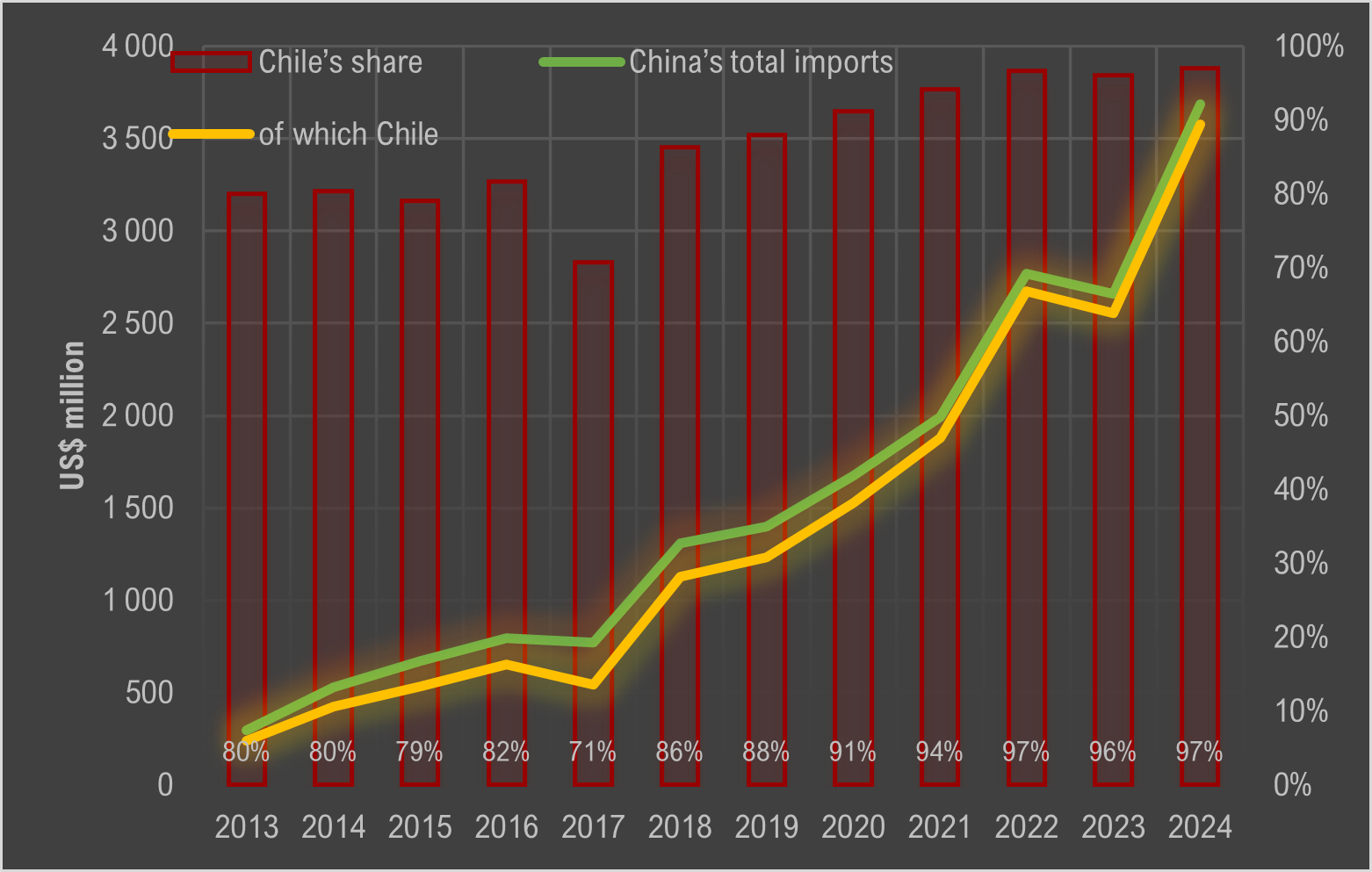
In 2024, three countries accounted for almost 72% of South African cherry exports: the United Kingdom (46%), the Netherlands (16%) and the United Arab Emirates (9%). Three Asian countries (Malaysia, Singapore and Cambodia) accounted for less than 10% of South African cherry exports. In the same year, South Africa ranked 23rd by value and 29th by volume among exporting countries, accounting for 0.13% and 0.09% of the world total respectively. The average price of South African cherries is US$7.76 per kilo, compared to a global average of US$5.49, and more strikingly against US$6.64 per kilo for cherries from Chile, its inescapable rival.
Under the most-favoured-nation clause, customs duties on cherries entering China stand at 10% for WTO member countries, and at 70% for all others. However, the two-year tariff exemption that South Africa has enjoyed since May 2026 will have no impact, as Chile has held a free trade agreement with China since 2005. As a consequence, all customs duties on fresh agricultural products have been waived for Chile since 2008. Unless South African supply increases enough to exert downward pressure on prices, South African cherries will remain more expensive than Chilean ones.
Therefore, the May 2026 (two-year) tariff exemption will have no measurable commercial effect on cherry imports on its own. The truly binding constraint was, in fact, not tariff-related but rather of a sanitary and phytosanitary in nature. It was not lifted until September 2026.


